The Tomb of Seyyid Mahmud Hayrani: A Sufi Sheikh and Akşehir’s Lion Legend
In the small Anatolian town of Akşehir, an hour’s drive from Konya, one of the most revered Sufis of Seljuk Anatolia—Seyyid Mahmud Hayrani—rests beneath the roof of a wooden ceremonial tomb. The 13th-century tomb, also known as the “Mahmûd-ı Hayrânî Türbesi” or “Tomb of Seydi Mahmut,” has been attracting pilgrims and lovers of medieval art for seven centuries. Seyyid Mahmud’s wooden coffin—a masterpiece of Seljuk carving, now housed in the Ethnography Museum in Ankara—is considered one of the finest examples of Islamic wood art in Anatolia.
The History and Life of Seyyid Mahmud Hayrani
Seyyid Mahmud Hayrani (dates of life are approximate—around 1200–1268, according to other sources, he died in 1268 or 1273) was a Sufi sheikh, a descendant (seyyid) of the Prophet Muhammad, a preacher, and a poet who lived during the late Seljuk Sultanate of Rum. He was a disciple of the great sheikh Evhadeddin Kirmani and a mentor to many local Sufis. According to legend, Seyyid Mahmud met Mevlana Celaleddin Rumi and influenced him, although the historical accuracy of this meeting is disputed.
The most famous legend about Seyyid Mahmud is the story of how he rode into Akşehir on a lion, holding a snake in his hand instead of a whip. This scene, symbolizing the saint’s spiritual power over the wild forces of nature, became a canonical image of Anatolian Sufism and was depicted many times in miniatures and folk art. According to one version of the legend, upon seeing this, the local sheikh Nasreddin Hoca (also from Akşehir) smiled and said, “I will come to him riding a wall”—and indeed rode up on top of a fence. This pair of legends connects the two most famous figures of Akşehir.
Seyyid Mahmud died in Akşehir and was buried in a specially built tomb. The modern türbe took shape in the 13th century and has undergone several renovations. The wooden coffin (a symbolic sarcophagus) of exceptional craftsmanship was moved to the Ethnographic Museum in Ankara in 1934, where it remains today; a replica is installed in the tomb itself. The türbe in its current form is a 20th-century restoration.
Architecture and What to See
Exterior of the türbe
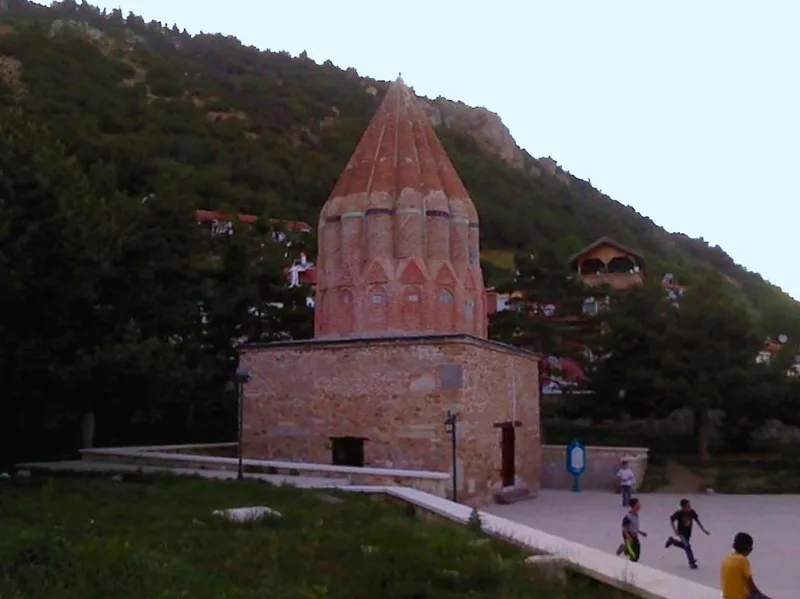
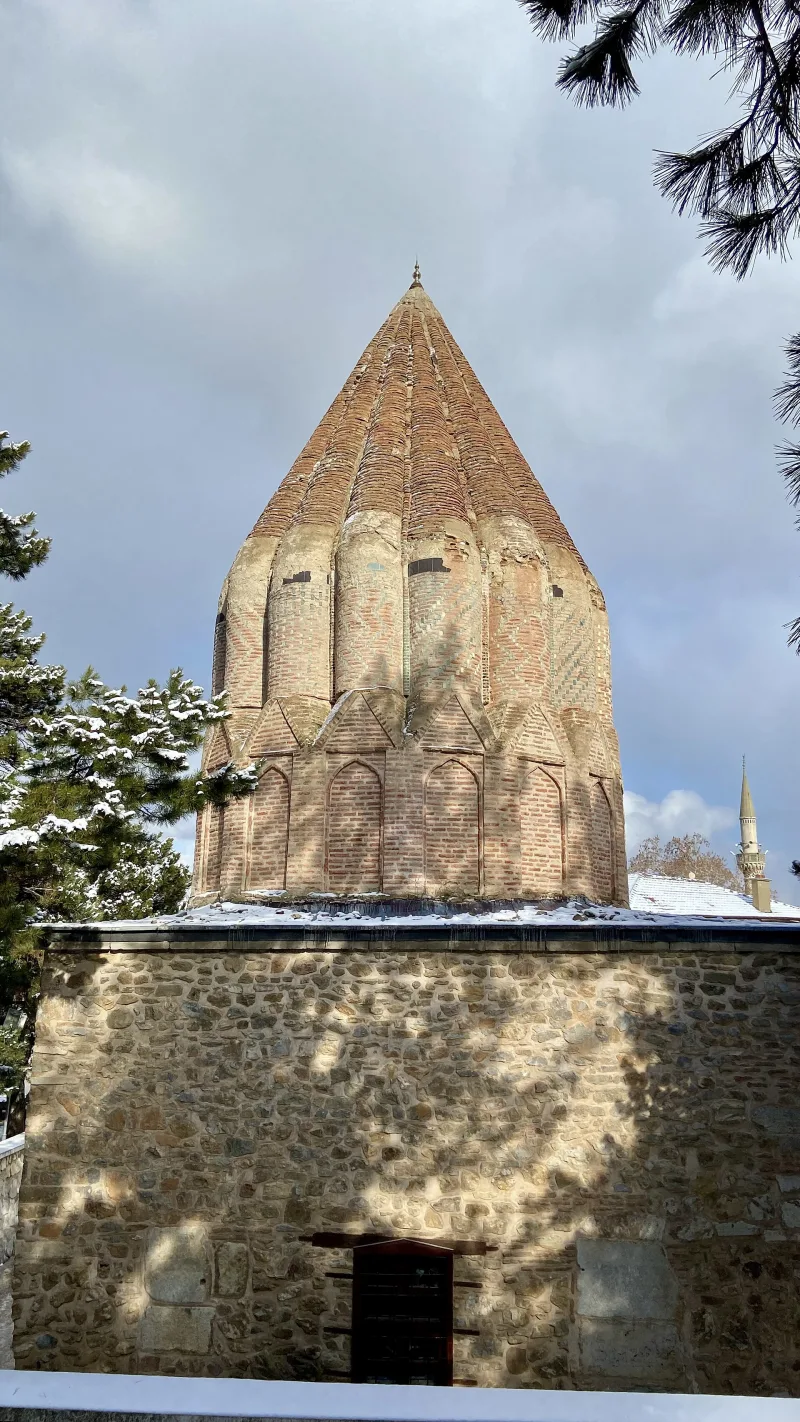
The tomb is a small stone building with a pyramidal roof—a typical Anatolian Seljuk kümbet. The walls are built of hewn stone, and the facade is decorated with understated carvings. In front of the entrance is a small portico with two columns. The low minaret nearby is a later addition, built during the Ottoman period.
Interior and sarcophagus
The interior is compact: a square room covered by a dome, with a sarcophagus (coffin) covered in green cloth at the center. This is a replica—the original, crafted from walnut in 1273 by the local master Hace Yusuf bin Ebu Bekir, is kept in Ankara. The original sarcophagus is a masterpiece of Seljuk woodcarving: eight panels with floral ornamentation, arabesques, and calligraphic inscriptions (Quranic verses and an epitaph) executed in the Kufi and Suls scripts. Experts generally agree that this is one of the finest examples of 13th-century Islamic wood art in Anatolia.
Carved door and portal
The wooden door of the main entrance to the türbe is also a work of Seljuk carving, decorated with floral and geometric motifs. The portal is framed by stone carvings with stalactite muqarnas at the top.
Surrounding cemetery
Surrounding the türbe is a small historic cemetery where the followers and descendants of Seyyid Mahmud, as well as local sheikhs from later eras, are buried. Some of the tombstones date back to the 15th–17th centuries and are of interest in their own right as examples of Ottoman carved epigraphy.
Interesting Facts
- The legend of Seyyid Mahmud, who entered Akşehir riding a lion with a snake instead of a whip, is one of the most widespread themes in Anatolian Sufi folklore and appears in miniatures from the 15th–17th centuries.
- The original Seyyid Mahmud chest, dating from 1273, is housed in the Ethnographic Museum in Ankara and is considered one of the key exhibits of Seljuk art in Turkey.
- Akşehir is also home to the tomb of Nasreddin Hoca (13th century)—the famous folk sage and hero of parables; both sites are usually visited together.
- One of Akşehir’s oldest mosques, located nearby, also bears the name of Seyyid Mahmud.
- Seyyid Mahmud Memorial Day (Hayrani Yıldız Anma Günü) is celebrated by the local community in early July.
How to get there
The tomb is located in the center of Akşehir, a district of Konya Province. Akşehir is situated 145 km northwest of Konya along Highway D300. The most convenient way to get there is by car (about 1 hour 45 minutes) or by intercity bus from Konya, Ankara (350 km, 4 hours), or İzmir.
Akşehir is a hub city on the main Konya–Afyonkarahisar–Istanbul railway line; the train station is located in the very center of the city, 1.5 km from the türbe. The nearest airports are Konya (KYA, 145 km) and Afyonkarahisar (AFY, 110 km).
In the city itself, the tomb is easily accessible on foot from the center; dolmuşes and taxis are also available. Nearby, in the Sakahane district, lies the tomb of Nasreddin Hoca—a must-see on any trip to Akşehir.
Tips for travelers
Türbe Seyyid Mahmud is an active place of pilgrimage, and although it is not a mosque in the strict sense of the word, it is advisable to observe general rules of decorum when visiting: remove your shoes at the entrance to the tomb chamber; women should cover their heads with a scarf and dress modestly. Inside, you must not make noise or use a flash when taking photos.
Admission is free. The best time to visit is in the morning, when there are few people and the interior is well-lit. The Türbe is usually open during daylight hours; sometimes a caretaker is on duty, ready to tell you about the saint and the history of the site.
To see Seyyid Mahmud’s original coffin, visit the Ethnography Museum in Ankara (Etnografya Müzesi) separately—it is on permanent display and is considered one of the museum’s main exhibits. In Akşehir itself, focus on a walking route: the Seyyid Mahmud türbe, the Nasreddin Hoca türbe, Ulu Camii (13th century), Taş Medrese, and the Akşehir Museum with its rich archaeological collection.
Akşehir is also famous for its cherries—the local “Napolyon” variety is considered one of the best in Turkey. During the season (June), the city hosts the annual Kiraz Festivali. Combining a visit to the türbe with tasting fresh fruit at the local bazaar is a delightful part of the trip.